

Wellness is one of the most interesting — and most contested — spaces in AI search. The category spans a vast range: evidence-based health and fitness content at one end, functional supplements and alternative practices in a murky middle, and outright misinformation at the other. AI systems know this. They’re specifically calibrated to navigate health and wellness content carefully, to weigh authoritative sources, and to be skeptical of claims that don’t have scientific backing.
For legitimate wellness brands — whether you’re a fitness platform, a nutritional supplement company with solid clinical backing, a mental wellness app, or a lifestyle health publisher — this creates both a challenge and an opportunity. The challenge: the bar for AI citation in wellness is genuinely high. The opportunity: most wellness brands aren’t doing the work to clear that bar, which means the ones that do stand out significantly.
What AI Systems Think of Wellness Content
It’s useful to understand how AI models approach wellness queries before thinking about how to optimize for them.
For straightforward wellness queries — “how many calories should I eat per day?”, “what are the benefits of strength training?” — AI tools will cite established, authoritative sources. Mayo Clinic, NHS, peer-reviewed nutritional bodies, well-credentialed fitness publications. The threshold here is quality and credibility.
For supplement and alternative wellness queries — “does ashwagandha reduce cortisol?”, “is intermittent fasting effective for weight loss?” — AI tools tend to be more nuanced, acknowledging where evidence is solid, where it’s preliminary, and where it’s absent. They’ll cite research when it exists and be cautious when it doesn’t.
For trend-driven wellness queries — “what is cortisol face?”, “should I try seed cycling?” — AI tools often provide balanced assessments that include expert skepticism. They’re not just citing whoever ranks highest; they’re synthesizing the quality of the evidence.
This means wellness AEO isn’t primarily about volume or technical tricks. It’s about genuine substance.
E-E-A-T as an AEO Strategy, Not Just an SEO Checkbox
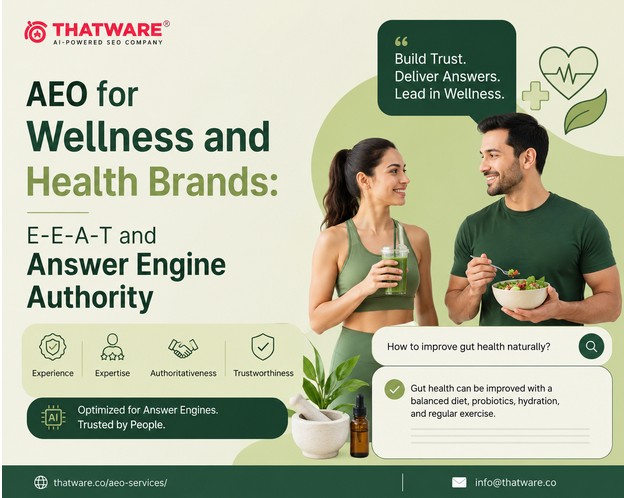
Experience, Expertise, Authoritativeness, Trustworthiness — Google’s E-E-A-T framework was developed specifically for YMYL content, and wellness is deep in that territory. But in the AI era, E-E-A-T isn’t just a content quality signal for Google’s algorithms. It’s effectively what AI systems use to evaluate which wellness sources to trust.
Experience: Does the content reflect real, lived, or practical experience with the topic? Personal accounts, practitioner case studies, client outcome data — these signals of genuine experience differentiate content from abstract theorizing.
Expertise: Is the content created by or reviewed by people with relevant credentials? RDs for nutrition content, certified personal trainers or exercise physiologists for fitness, licensed therapists for mental wellness. Clear bylines with real credentials.
Authoritativeness: Is the brand recognized externally as an authority in its wellness niche? Third-party mentions, media coverage, awards, professional organization memberships — the external validation layer.
Trustworthiness: Is the content accurate, appropriately caveated, and transparently sourced? Does the brand correct errors? Is it transparent about commercial relationships?
Wellness brands that genuinely embody these four dimensions aren’t just optimizing for AI citation — they’re building sustainable brand equity.
Building the External Authority Footprint
This is where many wellness brands are weakest. They have strong owned content but thin external authority signals.
Entity optimization for answer engines starts with understanding how your brand is currently represented across the web — and for most wellness brands, the answer is: inconsistently, and mostly through their own channels.
Building the external footprint in wellness involves:
Pursuing features and contributions in established wellness and health publications — not low-authority content farms, but genuinely credible platforms like Well + Good, Healthline’s editorial content (not advertorial), medical news platforms, fitness trade publications.
Getting your clinical or expert advisors quoted in media coverage. A registered dietitian on your advisory board who’s quoted in a Bloomberg Health piece creates an authority signal that AI systems can triangulate.
Publishing original data and research. If you have user outcome data, behavioral patterns, or clinical collaboration results — publish it in a citable format. Original data gets cited.
Building structured profiles on professional and wellness directories where relevant (Healthgrades, Psychology Today for therapist networks, ACE and NASM databases for fitness professionals).
Content That Actually Works
Wellness content for AI citation needs to walk a line: accessible enough for the broad audiences asking wellness questions, substantive enough to be credibly cited.
A few formats that perform consistently:
Evidence-based deep dives. Not “10 reasons to try yoga” but “what does the research actually say about yoga for anxiety?” — with real citations, honest assessment of evidence quality, and appropriate caveats.
Practical how-to content. Specific, actionable guides. “How to set up a progressive overload strength training program” — detailed, expert-reviewed, structured step-by-step — is exactly the format AI systems lean toward when answering practical wellness queries.
Myth vs. reality content. Wellness is full of popular myths. Content that directly addresses misinformation — citing the evidence accurately — positions your brand as a trusted corrective voice, which AI systems value highly in this space.
Glossary and concept definitions. “What is metabolic adaptation?”, “What is the thermic effect of food?” — clear, accurate wellness concept definitions are consistently cited.
The Supplement and Product Claim Challenge
For brands selling wellness products — supplements, fitness equipment, recovery technology — the AEO challenge is specific: you cannot make health claims that aren’t substantiated, and AI systems are becoming increasingly good at identifying promotional content masquerading as information.
The approach that works: educational content that’s genuinely informative about the ingredient, mechanism, or use case, with appropriate scientific sourcing, and a clear distinction between what the research supports and what’s speculative. Your product pages are for your products. Your educational content is for your audience.
AEO services for wellness brands help draw this distinction clearly and build the content architecture that separates authoritative educational content from promotional material — because AI systems are making that distinction whether you plan for it or not.
Patience Is the Wellness Brand’s Competitive Advantage
The wellness brands that will dominate AI citation over the next two to three years are the ones building genuine authority now — not chasing shortcuts or pumping out thin, trend-reactive content.
In a space where AI systems are specifically calibrated to filter out low-quality wellness information, consistent investment in credibility compounds. And the brands that clear the bar early will benefit from exactly the kind of durable citation authority that makes AI search visibility genuinely valuable.
Start with substance. Structure it well. Build the external signals. The rest follows.